According to the Financial Times, a recent investigation has uncovered new evidence of deepening China-Russia military industrial cooperation, revealing that a Chinese drone component executive has quietly acquired an equity stake in Rustact, a key Russian producer of FPV drones used extensively in the war against Ukraine.
The discovery points to a new level of financial alignment between Chinese commercial actors and Russia's sanctioned defense sector, extending beyond previously documented component trade.
Chinese Investor Identified in Russian Defense Firm
Corporate filings show that Wang Dinghua (王定华), a Shenzhen-based businessman and shareholder of Shenzhen Minghuaxin Technology Co., Ltd. (深圳市铭华鑫科技有限公司), recently acquired a 5% stake in Rustact.
Rustact manufactures the widely deployed VT-40 FPV drone and plays a central role in Russia's "Doomsday" drone initiative. The company is currently under sanctions by both the European Union and Ukraine.
This appears to be the first publicly documented instance of a Chinese-linked individual taking direct equity ownership in a sanctioned Russian defense contractor.
The development represents a potential escalation from commercial trade in dual-use components to direct participation in Russia's arms production ecosystem.
Russian Authorities Remove Ownership Records
The sensitivity of the ownership link became apparent shortly after the information was accessed.
The shareholder information naming Wang was visible in Russia's Unified State Register of Legal Entities when the documents were initially obtained. However, within 24 hours:
- All shareholder records for Rustact were removed from the official Russian register
- Corresponding data disappeared from several private corporate intelligence databases
The rapid removal appears to reflect official efforts to obscure foreign involvement in Russia's sanction-affected military sector. Analysts note that such swift alterations are highly unusual and suggest awareness of potential geopolitical implications.
Network of Shenzhen Firms Connected to the Investor
Here is the shareholder structure of Shenzhen Minghuaxin Technology:
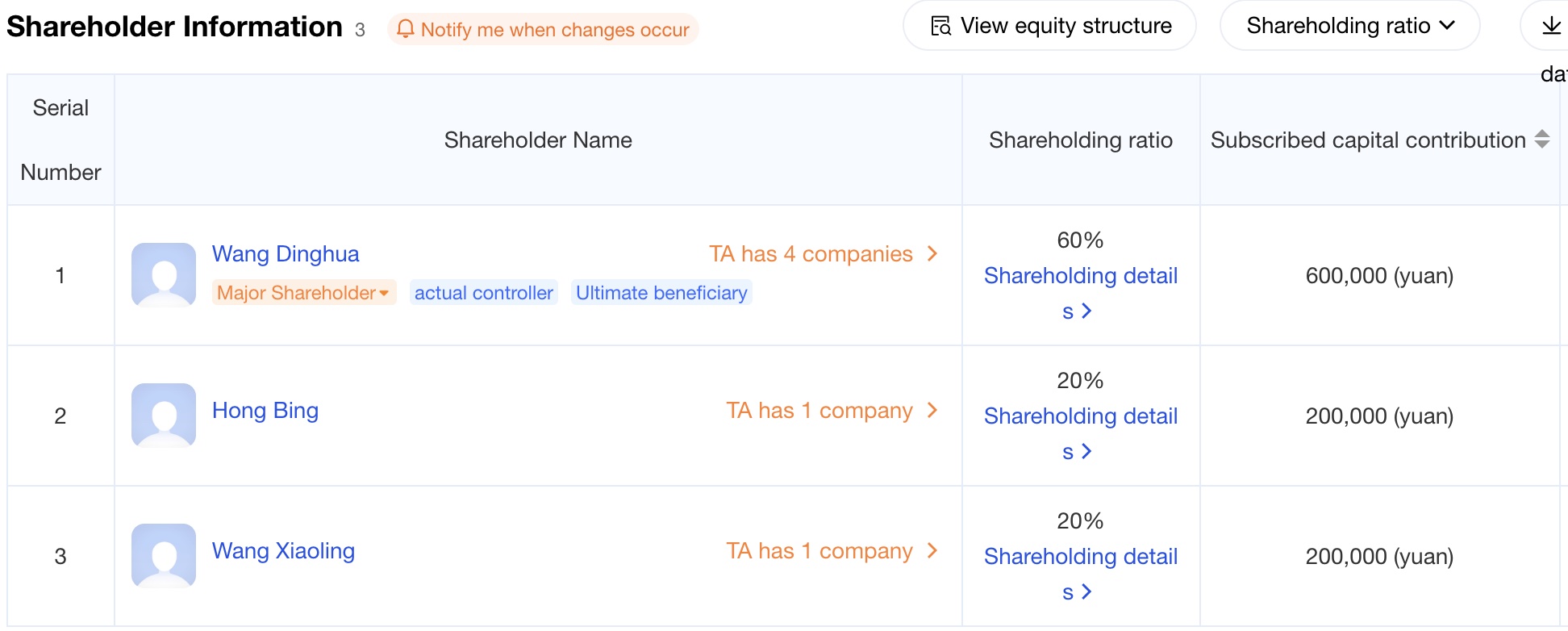
As shown in the chart, Wang Dinghua holds a 60% stake in the company, giving him clear majority control.
Public business records on Aiqicha indicate that Wang Dinghua is a shareholder or executive in multiple Shenzhen-based electronics suppliers, including:

| Company | Register Code | Chinese Name | Role |
|---|---|---|---|
| Shenzhen Minghuaxin Technology Co., Ltd. | 91440300MA5H43KY7H | 深圳市铭华鑫科技有限公司 | Shareholder / Executive |
| Shenzhen KIOSK Electronics Co., Ltd. | 91440300MA5EC9L105 | 深圳卡思科电子有限公司 | Shareholder |
| Shenzhen Nasiming Technology Co., Ltd. | 91440300MA5DPJ1B2D | 深圳市那斯明科技有限公司 | Shareholder / Executive |
| Shenzhen Zhinengyifang Technology Co., Ltd. | 914403005800836653 | 深圳市智能易房科技有限公司 | Executive |
These companies are not currently sanctioned. However, their executive-level ties to a shareholder of a sanctioned Russian military manufacturer may raise due-diligence and compliance concerns for international regulators.
Industry sources note that Shenzhen Minghuaxin and related firms supply components commonly used in small UAV systems similar to those deployed on the Ukrainian battlefield.
🛑 Call for Regulatory Review and Potential EU Action
Based on these findings, this investigation recommends that relevant European Union authorities open an immediate review into Shenzhen Minghuaxin, Shenzhen CASCO Electronics, and Shenzhen Nasiming Technology to assess whether these entities have provided material support financial or logistical to a sanctioned Russian defense enterprise.
Depending on the results of such a review, the companies may face:
- Potential inclusion on EU or Ukrainian sanctions lists
- Export-control restrictions
- Increased scrutiny of cross-border transactions
If confirmed, the investment connecting a Chinese executive to Rustact would represent a substantial advancement in China–Russia defense cooperation tied to the invasion of Ukraine.